
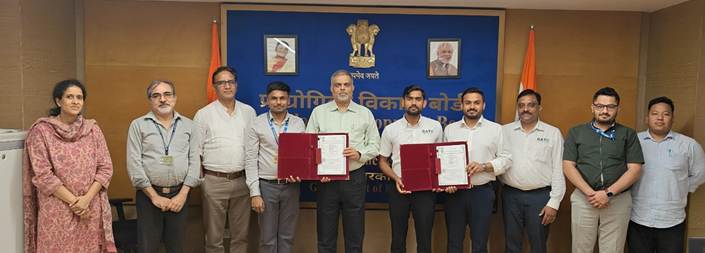
The Technology Development Board (TDB), under the Department of Science & Technology (DST), Government of India, has extended financial support to M/s BatX Energies Pvt. Ltd., Gurugram, to commercialize its indigenous battery recycling technology.
The project, titled “Technologies for generation of battery grade materials and value addition through closed loop,” will enable large-scale recovery of lithium, cobalt, nickel, and manganese from end-of-life lithium-ion batteries. BatX Energies has developed a proprietary low-temperature, low-pressure hydrometallurgical process, agnostic to battery chemistries, achieving high recovery rates of 97–99%.
This dual-mode (wet and dry) black mass recovery technology includes collection, shredding, metal leaching, and purification — all developed and patented in-house, thus reducing dependency on imported equipment and critical minerals.
The commercial facility aims to scale from a successful pilot to a full-fledged operation, supporting India’s goals under Aatmanirbhar Bharat and promoting a circular economy by minimizing mineral imports.
Shri Rajesh Kumar Pathak, Secretary, TDB, emphasized that robust recycling infrastructure is vital for India’s clean energy and electric mobility goals. “Indigenous technologies like this one enhance our energy security and innovation leadership,” he said.
Utkarsh Singh, Co-Founder and CEO of BatX Energies, stated, “TDB’s support validates our clean-tech mission and empowers us to globally lead in battery recycling. This is a leap forward in reducing critical mineral imports.”
BatX has filed seven patents (two granted) and developed a process that meets global specifications. The recovered lithium carbonate, cobalt sulphate, and other compounds are suitable for both domestic use and export, further strengthening India’s presence in the clean energy value chain.
This initiative marks a major step toward building a sustainable, self-reliant, and technology-driven ecosystem for battery materials and green energy.
Source: PIB

