
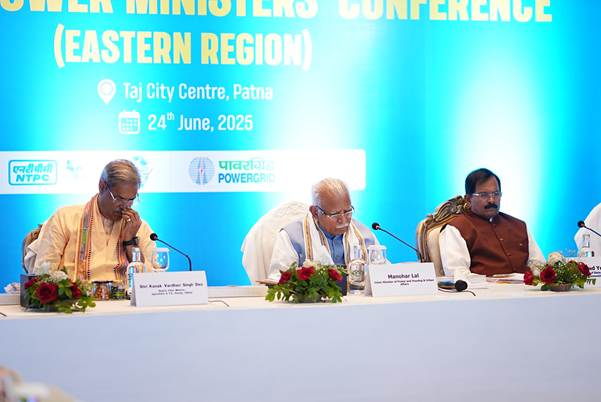
Union Minister of Power and Housing & Urban Affairs Shri Manohar Lal chaired the Regional Conference for Eastern Region States and UTs held in Patna. The event was attended by ministers and senior officials from Bihar, Odisha, Jharkhand, and other key stakeholders from the power sector.
In his address, the Minister emphasized India’s evolution from a power-deficit to a power-surplus nation, highlighting the importance of meeting the projected peak demand of 270 GW later this year. He urged states to formulate balanced resource adequacy plans and tie up necessary generation capacities—including nuclear power—with a goal of having at least one nuclear plant per state.
Shri Manohar Lal stressed the need to strengthen intra-state transmission through Tariff Based Competitive Bidding (TBCB) and encouraged states to utilize the ₹1.5 lakh crore, 50-year interest-free loans announced in the Union Budget 2025–26 for infrastructure development.
He called on states to promote renewable energy with energy storage and boost smart metering efforts. The share of renewable energy has grown from 32% in 2014 to 49% in April 2025, and the goal is to reach 100 GW of nuclear energy by 2047.
The Minister outlined that all government buildings must have prepaid smart meters installed by August 2025, with smart meters for commercial and high-load consumers in place by November 2025. These efforts are expected to enhance billing efficiency and reduce AT&C losses.
He also addressed the need for cybersecurity in the power sector and the adoption of islanding schemes to ensure grid resilience. Further, he encouraged financial reforms for distribution utilities, better tariff structures, and timely payments by government departments.
Union Minister Shripad Yesso Naik urged for the speedy implementation of the PM KUSUM and PM Surya Ghar Muft Bijli Yojana schemes. Secretary (Power) echoed the need for sustained coordination among states to ensure long-term energy sustainability and infrastructure resilience.
Source: PIB


